Caracterización acústica del repertorio vocal de la Vicugna vicugna (Artiodactyla: Camelidae) en cautiverio: descripción y análisis espectrográfico
Autores/as
-
María Laura Chaves
Cátedra de Comportamiento Animal, Facultad de Ciencias Naturales e Instituto Miguel Lillo, Universidad Nacional de Tucumán (UNT)
 https://orcid.org/0009-0009-5019-9242
- Alejandra Hurtado Cátedra de Comportamiento Animal, Facultad de Ciencias Naturales e Instituto Miguel Lillo, Universidad Nacional de Tucumán (UNT)
- Flavia Patricia Rodriguez Cátedra de Comportamiento Animal, Facultad de Ciencias Naturales e Instituto Miguel Lillo, Universidad Nacional de Tucumán (UNT)
DOI:
 https://doi.org/10.30550/j.azl/2391
Palabras clave:
Camélidos, Comunicación, Espectrograma, FormantesResumen
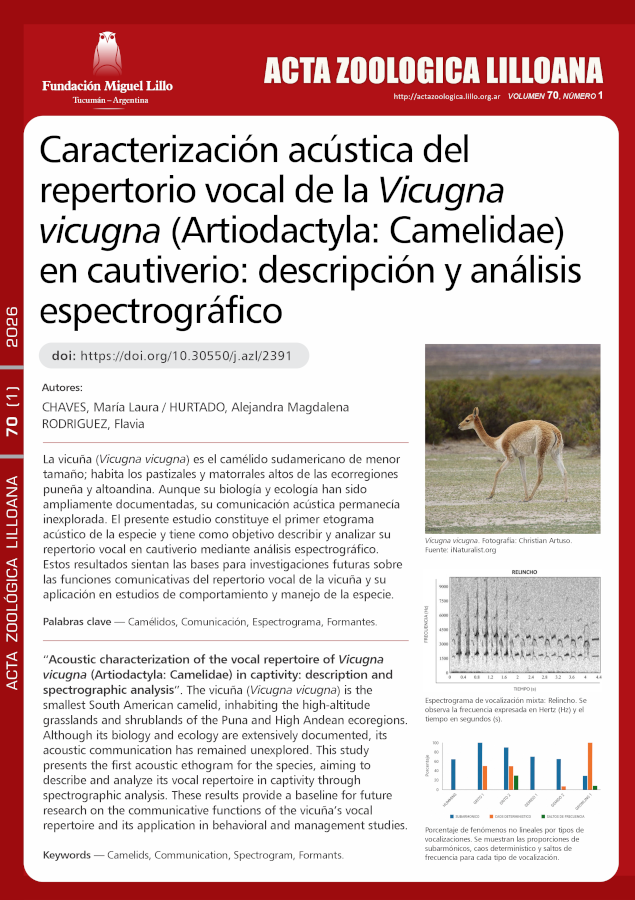
La vicuña (Vicugna vicugna) es el camélido sudamericano de menor
tamaño; habita los pastizales y matorrales altos de las ecorregiones
puneña y altoandina. Aunque su biología y ecología han sido amplia-
mente documentadas, su comunicación acústica permanecía inexplo-
rada. El presente estudio constituye el primer etograma acústico de la
especie y tiene como objetivo describir y analizar su repertorio vocal en
cautiverio mediante análisis espectrográfico. Los registros se obtuvieron
en el Campo Experimental de Altura INTA Abra Pampa (Jujuy), donde
las vicuñas estaban alojadas en corrales con grupos mixtos de edad y
sexo. Se identificaron 10 vocalizaciones, clasificadas en tonales (balido,
humming, grito 1, grito 2, gemido 1 y gemido 2), ruidosas (bramido,
growling 1 y growling 2) y una mixta (relincho). La frecuencia fundamental (F0) demostró alto poder discriminatorio entre tipos vocales. Siguiendo a la Teoría Fuente-Filtro, se identificaron vocalizaciones que codifican información sobre el tamaño corporal del emisor, el análisis de formantes del gemido 1 y el bramido permitió estimar la longitud
teórica del tracto vocal (VTL) en 17,8 cm, valor próximo al obtenido
mediante medición directa de cráneos (16,72 cm). Se identificaron Fe-
nómenos no Lineales, que pueden contener información individual va-
riada, en cinco vocalizaciones tonales y una ruidosa. Las características
espectrográficas del relincho son consistentes con una adaptación para
la transmisión a larga distancia. Estos resultados sientan las bases para
investigaciones futuras sobre las funciones comunicativas del repertorio
vocal de la vicuña y su aplicación en estudios de comportamiento y
manejo de la especie.
Descargas
Citas
Alcock, J. (2001). Animal Behavior: An evolutionary approach (7th ed.). Sinauer Associates.
Anikin, A., Pisanski, K., Massenet, M., & Reby, D. (2021). Harsh is large: nonlinear vocal phenomena lower voice pitch and exaggerate body size. Proceedings of the Royal Society of London B: Biological Sciences, 288, 2021-0872. https://doi.org/10.1098/rspb.2021.0872 DOI: https://doi.org/10.1098/rspb.2021.0872
Anikin A, Pisanski K, Reby D.(2020) Do nonlinear vocal phenomena signalnegative valence or high emotion intensity? Royal Societi Open Science. 7: 201306. https://doi.org/10.1098/rsos.201306 DOI: https://doi.org/10.1098/rsos.201306
Arzamendia Y. y Vilá B.L. 2003. Estudios de comportamiento y organización social de vicuñas, en la RB Laguna de Pozuelos, Jujuy, Argentina, como línea de base para el manejo sostenible de la especie. III Congreso Mundial sobre Camélidos, Potosí, Bolivia, 15-18 de octubre.
Baotic, A., Sicks, F., & Stoeger, A. S. (2015). Nocturnal “humming” vocalizations: adding a piece to the puzzle of giraffe vocal communication. BMC Research Notes, 8, 425. https://doi.org/10.1186/s13104-015-1394-3 DOI: https://doi.org/10.1186/s13104-015-1394-3
Blumstein, D., & Récapet, C. (2009). The sound of arousal: the addition of novel non-linearities increases responsiveness in marmot alarm calls. Ethology, 115, 1074–1081. https://doi.org/10.1111/J.1439-0310.2009.01691.X DOI: https://doi.org/10.1111/j.1439-0310.2009.01691.x
Bradbury, J. W., & Vehrencamp, S. L. (2011). Principles of animal communication (2nd ed.). Sunderland, Massachusetts: Sinauer Associates.ISBN: 9780878930456
Briefer, E. F. (2012). Vocal expression of emotions in mammals: mechanisms of production and evidence. Journal of Zoology, (288) 1-20. https://doi.org/10.1111/j.1469-7998.2012.00920.x DOI: https://doi.org/10.1111/j.1469-7998.2012.00920.x
Carazo, P., & Font, E. (2010). Putting information back into biological communication. Journal of Evolutionary Biology, (23), 661-669. https://doi.org/10.1111/j.1420-9101.2010.01944.x DOI: https://doi.org/10.1111/j.1420-9101.2010.01944.x
Daniel, J. C., and Blumstein, D. T. (1998). A test of the acoustic adaptation hypothesis in four species of marmots. Animal Behavior. (56), 1517–1528. https://doi.org/10.1006/anbe.1998.0929 DOI: https://doi.org/10.1006/anbe.1998.0929
Ey, E., & Fischer, J. (2009). The “acoustic adaptation hypothesis”: a review of the evidence from birds, anurans and mammals. Bioacoustics, (19), 21–48. https://doi.org/10.1080/09524622.2009.9753613 DOI: https://doi.org/10.1080/09524622.2009.9753613
Fitch, W. T., Neubauer, J., Herzel, H. (2002). Calls out of chaos: The adaptive significance of nonlinear phenomena in mammalian vocal production. Animal Behaviour, (63) 407-418. https://doi.org/10.1006/anbe.2001.1912 DOI: https://doi.org/10.1006/anbe.2001.1912
Fitch, W. T. (2006). Production of vocalizations in mammals. En: Encyclopedia of Language and Linguistics (115-121). University of St Andrews, St Andrews, UK. https://doi.org/10.1016/B0-08-044854-2/00821-X DOI: https://doi.org/10.1016/B0-08-044854-2/00821-X
Fitch, W. T., Anikin, A., Pisanski, K. et al. (2025). Formant analysis of vertebrate vocalizations: achievements, pitfalls, and promises. BMC Biology, (23) 92. https://doi.org/10.1186/s12915-025-02188-w DOI: https://doi.org/10.1186/s12915-025-02188-w
Fitch WT, Hauser MD. (2003) Unpacking “Honesty”: vertebrate vocal production and the evolution of acoustic signals. In: Simmons AM, Fay RR, Popper AN, editors. Acoustic communication. New York, NY: Springer.
Franklin, W. L. (1974a). The social behavior of the vicuna. En Behaviour of ungulates and its relation to management (477–487). IUCN.
Franklin, W. L. (1983b). Contrasting socioecologies of South America’s wild camelids: the vicuña and the guanaco. Advances in the study of mammalian behavior, 7, 573-629. ISBN 0934612063
Fowler, M. E. (2008). Behavioral clues for detection of illness in wild animals: models in camelids and elephants. En Zoo and Wild Animal Medicine (pp. 33-cp3). WB Saunders. DOI: https://doi.org/10.1016/B978-141604047-7.50007-5 DOI: https://doi.org/10.1016/B978-141604047-7.50007-5
Ghazanfar, A. A., Turesson, H. K., Maier, J. X., van Dinther, R., Patterson, R. D., & Logothetis, N. K. (2007). Vocal-tract resonances as indexical cues in rhesus monkeys. Current biology, (17) 425–430. https://doi.org/10.1016/j.cub.2007.01.029 DOI: https://doi.org/10.1016/j.cub.2007.01.029
Hoffman, R., Otte, K., Ponce, C. F., Ríos, M. A. (1983). El manejo de la vicuña silvestre. Eschborn: Sociedad Alemana de Cooperación Técnica (GTZ). ISBN3-88085-113-1
Hopp, S. L., Owren, M. J., y Evans, C. S. (Eds.). (1998). Animal acoustic communication: Sound analysis and research methods. Springer. https://doi.org/10.1007/978-3-642-76220-8 DOI: https://doi.org/10.1007/978-3-642-76220-8
Hurtado, A. M.; Smith-Flueck, J. A.; y Black-Decima. (2011). Description of vocalizations in exotic European red deer stags (Cervus elaphus) during the rut in Northwestern Patagonia (Argentina). Animal Production Science 51(4) cvi-cviv. ISSN: 1836-5787
Krebs, J. R., Davies, N. B., Parr, J. (1993). An introduction to behavioural ecology (3rd ed.). Blackwell Scientific Publications. ISBN: 0632035463
Koford, C.B. (1957). The Vicuna and the Puna. Ecological Monographs, (27) 153-219. DOI: https://doi.org/10.2307/1948574 DOI: https://doi.org/10.2307/1948574
Lichtenstein, G. (2006). Manejo de vicuñas en cautiverio: el modelo de los criaderos de INTA Abrapampa. En B. Vilá (Ed.), Investigación, conservación y manejo de vicuñas (pp. 143–158). Proyecto MACS - Buenos Aires.
McComb, K., Reby, D. (2010). Communication in terrestrial animals. En Encyclopedia of Neuroscience. Oxford: Academic Press. https://doi.org/10.1016/B978-008045046-9.01863-5 DOI: https://doi.org/10.1016/B978-008045046-9.01863-5
Muir J, Herbst CT, Hawes JE,O’Mahoney T, Dunn JC. 2025 Nonlinear phenomena in mammalian vocal communication: an introduction and scoping review. Phil. Trans. R. Soc. B 380: 20240017. https://doi.org/10.1098/rstb.2024.0017 DOI: https://doi.org/10.1098/rstb.2024.0017
Naguib, M., Wiley, R. H. (2001). Estimating the distance to a source of sound: mechanisms and adaptations for long-range communication. Animal Behaviour, (62) 825–837. https://doi.org/10.1006/anbe.2001.1860 DOI: https://doi.org/10.1006/anbe.2001.1860
Reby, D. y McComb, K. (2003). Anatomical constraints generate honesty: acoustic cues to age and weight in the roars of red deer stags. Animal Behaviour (65) 519–530. https://doi.org/10.1006/anbe.2003.2078 DOI: https://doi.org/10.1006/anbe.2003.2078
Riede, T., Arcadi, A. C., Owren, M. J. (2007). Nonlinear acoustics in the pant hoots of common chimpanzees (Pan troglodytes): vocalizing at the edge. The Journal of the Acoustical Society of America (121), 1758–1767. https://doi.org/10.1121/1.2427115 DOI: https://doi.org/10.1121/1.2427115
Riede, T., Brown, C. (2013). Body size, vocal fold length, and fundamental frequency–implications for mammal vocal communication. Nova Acta Leopoldina NF, (111) 295–314. (PDF) Body Size, Vocal Fold Length, and Fundamental Frequency – Implications for Mammal Vocal Communication.
Ruxton, G. D., Schaefer, H. M. (2011). Resolving current disagreements and ambiguities in the terminology of animal communication. Journal of Evolutionary Biology, (24) 2574–2585. https://doi.org/10.1111/j.1420-9101.2011.02386.x DOI: https://doi.org/10.1111/j.1420-9101.2011.02386.x
Scott-Phillips, T. C. (2008). Defining biological communication. Journal of Evolutionary Biology, (21) 387–395. https://doi.org/10.1111/j.1420-9101.2007.01497.x DOI: https://doi.org/10.1111/j.1420-9101.2007.01497.x
Smith, J. M. y Harper D. (2003) Animal Signals. Oxford Academic Press. ISBN: 9780198526841. https://doi.org/10.1093/oso/9780198526841.001.0001 DOI: https://doi.org/10.1093/oso/9780198526841.001.0001
Taylor, A. M., Reby, D., McComb, K. (2008). Human listeners attend to size information in domestic dog growls. The Journal of the Acoustical Society of America, (123) 2903–2909. https://doi.org/10.1121/1.2896962 DOI: https://doi.org/10.1121/1.2896962
Taylor, A.M., Charlton, B.D., Reby, D. (2016). Vocal Production by Terrestrial Mammals: Source, Filter, and Function. In: Suthers, R., Fitch, W., Fay, R., Popper, A. (eds) Vertebrate Sound Production and Acoustic Communication. Springer Handbook of Auditory Research, vol 53. Springer, Cham. https://doi.org/10.1007/978-3-319-27721-9_8 DOI: https://doi.org/10.1007/978-3-319-27721-9_8
Taylor, A. M., Reby, D. (2010). The contribution of source–filter theory to mammal vocal communication research. Journal of Zoology, (280) 221–236. https://doi.org/10.1111/j.1469-7998.2009.00661.x DOI: https://doi.org/10.1111/j.1469-7998.2009.00661.x
Tokuda, I. (2018) Non-linear dynamics in mammalian voice production. Anthropological Science, (126) 35-41. https://doi.org/10.1537/ase.171130 DOI: https://doi.org/10.1537/ase.171130
Volodina, E. V., Volodin, I. A., Isaeva, I. V., Unck, C. (2006). Biphonation may function to enhance individual recognition in the dhole, Cuon alpinus. Ethology, (112) 815-825. https://doi.org/10.1111/J.1439-0310.2006.01231.X DOI: https://doi.org/10.1111/j.1439-0310.2006.01231.x
Wilden, I., Herzel, H., Peters, G., Tembrock, G. (1998). Subharmonics, biphonation, and deterministic chaos in mammal vocalization. Bioacoustics, (9) 171-196. https://doi.org/10.1080/09524622.1998.9753394 DOI: https://doi.org/10.1080/09524622.1998.9753394
Descargas
- Material suplementario (audios)
- Material suplementario: balido
- Material suplementario: bramido
- Material suplementario: gemido (1)
- Material suplementario: gemido (2)
- Material suplementario: grito (1)
- Material suplementario: grito (2)
- Material suplementario: growl (1)
- Material suplementario: growl (2)
- Material suplementario: humm
- Material suplementario: relincho
Publicado
Cómo citar
Número
Sección
Licencia
Derechos de autor 2026 Acta Zoológica Lilloana

Esta obra está bajo una licencia internacional Creative Commons Atribución-NoComercial-SinDerivadas 4.0.