Temperature, an underestimated factor in the multiscale structural interpretation of exploratory targets for energy fluids
a review
Authors
-
Eduardo Antonio Rossello
IGEBA-CONICET, Depto. Ciencias Geológicas, Universidad de Buenos Aires
 https://orcid.org/0000-0002-6466-9956
DOI:
 https://doi.org/10.30550/j.agl/2340
Keywords:
Geothermal gradient, deformation, petrophysics, energy fluid resourcesAbstract
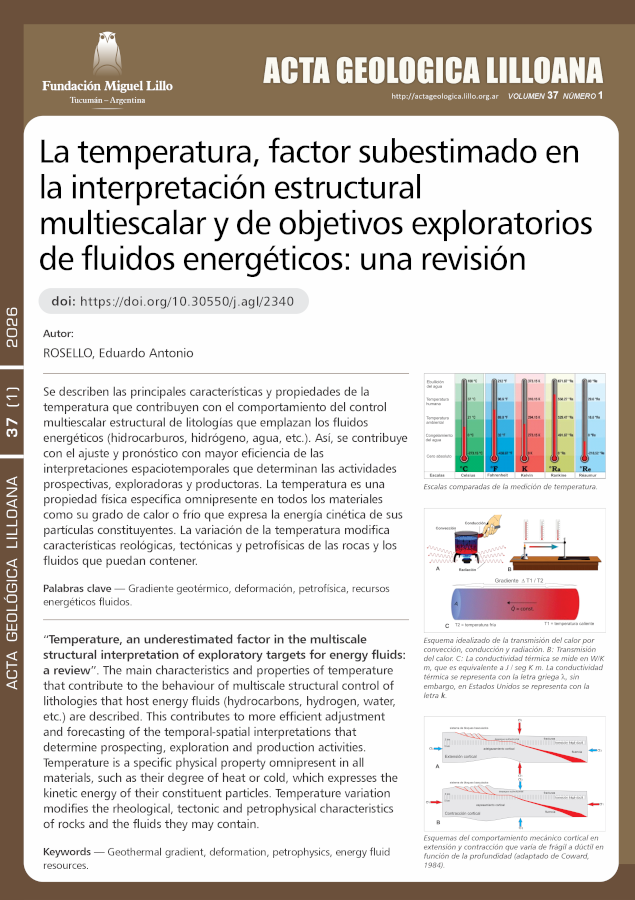
The main characteristics and properties of temperature that contribute to the behaviour of multiscale structural control of lithologies that host energy fluids (hydrocarbons, hydrogen, water, etc.) are described. This contributes to more efficient adjustment and forecasting of the temporal-spatial interpretations that determine prospecting, exploration and production activities. Temperature is a specific physical property omnipresent in all materials, such as their degree of heat or cold, which expresses the kinetic energy of their constituent particles. Temperature variation modifies the rheological, tectonic and petrophysical characteristics of rocks and the fluids they may contain. Thus, an increase in temperature in deep environments due to the influence of the geothermal gradient will cause an increase in volume due to expansion and a decrease in resistance. In this way, a stress field that exceeds the strength limit of a rock will produce continuous deformations without fractures and will tend to homogenise the response of sets of lithologies with anisotropic properties depending on the scales involved. The morphological and volumetric variations produced by temperature depend on the anisotropic characteristics of materials, which condition three-dimensional expansion-contraction and thermal conductivity. Minimal temperature changes can influence or impede fluid-reservoir relationships and behaviours related to solubility, viscosity, density, and electrical and thermal conductivity. In addition, temperature changes modify the densities that control both igneous and sedimentary diapirism, and the position of the cryosphere determines the maximum elevation of mountain ranges.
Downloads
References
Abdulagatova, Z., Abdulagatov, I.M, Emirov, V. 2009. Effect of temperature and pressure on the thermal conductivity of sandstone. International Journal of Rock Mechanics and Mining Sciences, 46: 1055-1071. doi.org/10.1016/j.ijrmms.2009.04.011
Abdulagatov, I.M., Emirov, S.N., Abdulagatova, Z.Z., Askerov, S.Y. 2006. Effect of pressure and temperature on the thermal conductivity of rocks. J. Chem. Eng. Data 51: 22-33.
Abdulagatov, I.M., Akhmedova-Azizova, L.A., Aliev, R.M., Badavov, G.B. 2016. Measurements of the density, speed of sound, viscosity and derived thermodynamic properties of geothermal ?uids from south Russia Geothermal Field. Part II. Applied Geochemistry 69: 28-41. http://dx.doi.org/10.1016/j.apgeochem.2016.04.003
Aguilera, R. 1980. Naturally fractured reservoirs. Petroleum Publishing Co. 703 pp. ISBN 0878141227, 9780878141227
Alareeq, N.M.A., Maky, A.F., Ramadan, M.A.M., Salman, A. 2013. Thermal conductivity, radiogenic heat production and heat flow of some Upper Jurassic rock units, Sabatayn Basin, Yemen. Journal of Applied Sciences Research, 9(1): 498-518. ISSN 1819-544X
Anderson, E.M. 1951. The dynamic of the faulting and dyke formation with application to Britain: Edinburgh, Oliver & Boyd, 206p.
Arndt, N. 2011. Geothermal gradient. In: Gargaud, M., Amils, R., Cernicharo Quintanilla, J., Cleaves, H.J., Irvine, W.M., Pinti, D.L., Viso, M. (eds.), Encyclopedia of Astrobiology. Springer, Berlin, Heidelberg. doi.org/10.1007/978-3-642-11274-4_643
Barcelona, H., Yagupsky, D., Vigide, N., Senger, M. 2019. Structural model and slip-dilation tendency analysis at the Copahue geothermal system: Inferences on the reservoir geometry, Journal of Volcanology and Geothermal Research. https://doi.org/10.1016/j.jvolgeores.2019.03.00
Bertrand, M. 1898. La nappe de recouvrement des environs de Marseille. Lame de charriage et rapprochement avec le bassin houiller de Silésie. Bulletin de la Société Géologique de France. XXVI: 632-652.
Birch, F., Clark, H. 1940. The thermal conductivity of rocks and its dependence upon temperature and composition, Part I. American Journal of Sciences, 238: 529-558.
Bogoliubov, N.N. 1949. On the theory of superconductivity. Journal of Physics, 11(3): 301-314.
Bolås, H., Hermanrud, C., Teige, G. 2004. Origin of overpressures in shales: Constraints from basin modeling. American Association of Petroleum Geologists, Bulletin 88. 193-211. 10.1306/10060302042.
Bowers, T.S. 1991. The deposition of gold and the other metals: Pressure-induced inmiscibility and associated stable isotope signatures. Geochimica et Cosmochimica Acta 55: 2417-2434.
Boyer, S.E., Elliott, D. 1982. Thrust systems. American Association of Petroleum Geologists, Bulletin 66 (9): 1196-1230.
Braunstein, G., O’Brien, G.D. 1968. Diapirism and diapirs. American Association of Petroleum Geologists. Memoir. doi.org/10.1306/M8361
Brigaud, F., Vasseur, G. 1989. Mineralogy, porosity and fluid control on thermal conductivity of sedimentary rocks: Geophysical Journal, 98: 525-542.
Brigaud, F., Chapman, D.S., Le Douaran, S. 1990. Estimating thermal conductivity in sedimentary basins using lithological data and geophysical well, log data. American Association of Petroleum Geologists, Bulletin, 74: 1459-1477.
Buntebarth, G., Schopper, J.R. 1998. Experimental and theoretical investigations on the influence of fluids, solids and interactions between them on thermal properties of porous rocks. Physics and Chemistry of the Earth 23: (9-10: 1141-114. doi.org/10.1016/S0079-1946(98)00142-6
Butler, R.W.H., Coward, M.P. 1984. Geological constraints, structural evolution, and deep geology of the northwest Scottish Caledonides. Tectonics, 3 (3): 347-365. doi:10.1029/tc003i003p00347
Carnot, S. 1824. Réflexions sur la puissance motrice du feu. Chez Bachelier (Paris). 142pp. http://books.google.com/books?id=QX9iIWF3yOMC&hl=&source=gbs_api
Çengel, Y.A., Boles, M.A. 2009. Temodinámica (7ta edición). Mc Graw Hill. 1041pp. ISBN 978-0-07-352932-5
Clauser, C. 1988. Opacitys the concept of radiative thermal conductivity. In: Hanel, R., Rybach, L., Stegena, L., (eds.), Handbook of terrestrial heat flow density determination. Kluwer: Dordrecht, The Netherlands,143-165.
Clauser, C., Huenges, E. 1995. Thermal conductivity of rocks and minerals. In: Ahrens, T.J. (ed.), Rocks physics and phase relations. A handbook of physical constants. American Geophysical Union, Chapter 3: 105-126.
Cobbold, P., Rossello, E., Vendeville, B. 1989. Some experiments on interacting sedimentation and deformation above salt horizons. Bulletin de la Société de Géologique de France, 5(3), 453-460. doi.org/10.2113/gssgfbull.V.3.453
Coward, M.P. 1984. Major shear zones in the Precambrian crust; examples from NW Scotland and southern Africa and their significance. In: Kroner, A., Greiling, R. (eds), Precambrian Tectonics Illustrated. Schweizerbart, Stuttgart, 207-235.
Davis, G.H., Reynolds, S.J. 1996. Structural geology of rocks and regions. John Wiley & Sons (2nd edition), 492 pp.
Davis, M.G., Chapman, D.S., Van Wagoner, T.M., Armstrong, P.A. 2007. Thermal conductivity anisotropy of metasedimentary and igneous rocks. Journal of Geophysical Research 112: B05216, doi:10.1029/2006JB004755
Dilles, J.H. 1987. Petrology of the Yerington Batholith, Nevada; evidence for evolution of porphyry copper ore fluids. Economic Geology, 82 (7): 1750-1789. doi:10.2113/gsecongeo.82.7.1750
Duchkov, A.D., Sokolova, L.S., Rodyakin, S.V., Chernysh, P.S. 2014. Thermal conductivity of the sedimentary-cover rocks of the West Siberian Plate in relation to their humidity and porosity. Russ. Geol. Geophys. Russian Geology and Geophysics, 55 (5-6): 784-792. doi.org/10.1016/j.rgg.2014.05.021
Duwiquet, H., Arbaret, L., Bellanger, M., Guillou-Frottier, L., Heap, M.J. 2019. Are crustal fault zones viable geothermal resources? Insights from the Pontgibaud Fault in French Massif Central. European Geothermal Congress (Den Haag). brgm.hal.science/hal-02149864/file/
Eswara Rao, S., Labani Ray, Tavheed Khan, G. Ravi 2022. Thermal conductivity, density, and porosity of sedimentary and metamorphic rocks from the Lower and Higher Himalaya, Western Himalaya, India. Geophysical Journal International 231(1): 459-473. doi.org/10.1093/gji/ggac176
Faulds, J.E., Coobaugh, M.F., Vice, G.S., Edwards, M.L. 2006. Characterizing structural controls of geothermal fields in the northwestern Great Basin: a progress report. Transactions – Geothermal Resources Council, 30: 69-76.
Fourier, J. 1822. Mémoire sur les temperaments et les chaleurs. Annales de Chimie et de Physique, 19: 257-285.
Fournier, R.O. 1999. Hydrothermal processes related to movement of fluid from plastic into brittle rock in the magmatic-epithermal environment: Economic Geology, 94(8): 1193-1211. doi.org/10.2113/gsecongeo.94.8.1193
Fournier, R.O., Potter II, R.W. 1982. An equation correlating the solubility of quartz in water from 25° to 900°C at pressures up to 10,000 bars. Geochimica and Cosmochimica Acta, 46(10): 1969-1973. doi.org/10.1016/0016-7037(82)90135-1
Fowler, A.D. 1995. Mineral crystallinity in igneous rocks. In: Barton, C.C., La Pointe, P.R. (eds.), Fractals in the Earth Sciences. Springer (Boston). 237-247. doi.org/10.1007/978-1-4899-1397-5_12
Frenzel, M., Woodcock, N.H. 2014. Cockade breccia: Product of mineralisation along dilational faults, Journal of Structural Geology, doi: 10.1016/j.jsg.2014.09.001.
Fuchs, S., Schütz, F., Förster, H-J., Förster, A. 2013 Evaluation of common mixing models for calculating bulk thermal conductivity of sedimentary rocks: correction charts and new conversion equations. Geothermics, 47: 40-52. doi.org/10.1016/j.geothermics.2013.02.002
Gabova, A., Popov, Y., Savelev, E., Romushkevich, R, Chekhonin, E., Plotnikov, V., Emelyanov, D., Akhmadishin, A. 2020. Experimental investigation of the effect of temperature on thermal conductivity of organic-rich shales. Journal of Petroleum Science and Engineering, 193:107438. doi.org/10.1016/j.petrol.2020.107438
García-Álvarez, V.O., López-Garello, C.M. 2005. Modelización del efecto de la dilatancia en materiales cuasi frágiles. Influencia en modo mixto de fractura. Anales de Mecánica de la Fractura, 22: 541-546.
Gdoutos, E., Konsta-Gdoutos 2024. Mechanical Testing of Materials. Springer Nature, 291 pp. SBN 978-3-031-45989-4
Gitifar, V., Abbasi, A., Setoodeh, P., Poursadegh, M., Sahebnazar, Z., Alamdari, A. 2014. Modelling and analysis of the thermal conductivities of air saturated sandstone, quartz and limestone using computational intelligence. International Journal of Thermal Sciences 83: 45-55.
Goto, S., Osamu, M. 2009. Relations between the thermal properties and porosity of sediments in the eastern flank of the Juan de Fuca Ridge. Earth Planets and Space. 61: 863-870. 10.1186/BF03353197.
Guilbert, J.M., Park, C.F. 1986. The geology of ore deposits. W.H. Freeman, 985pp. ISBN 0716714566, 9780716714569
Guo, P.Y., Zhang, N., He, M.C. Bai, B.H. 2017. Effect of water saturation and temperature in the range of 193 to 373 K on the thermal conductivity of sandstone. Tectonophysics 699: 121-128.
Gyu-Hyun Go, Seung-Rae Lee, Young-Sang Kim 2016. A reliable model to predict thermal conductivity of unsaturated weathered granite soils. International Communications in Heat and Mass Transfer, 74: 82-90. doi.org/10.1016/j.tecto.2017.01.024
Hambrey, M., Alean, J. 2004. Glaciers. Cambridge University Press (2nd ed.), 250 pp.
Hariharan, P. 2007. Basics of interferometry. Elsevier Inc. 213 pp. ISBN 0-12-373589-0.
Healy, D., Butler, R.W.H., Shipton, Z.K., Sibson, R.H. (eds.) 2012. Faulting, fracturing and igneous intrusion in the Earth’s Crust: Geological Society of London, Special Publications, 367: 1-6. doi.org/10.1144/SP367.0
Horai, K. 1971. Thermal conductivity of rock forming minerals. Journal of Geophysical Research, 76: 1278-1308.
Houpert, R., Homand, E. 1988. Données récentes sur le comportement des roches en fonction de la température. In: Berest, P., Weber, P (eds.), La thermomécanique des roches. Bureau de Recherches Géologiques et Minières. Manuel et méthodes 16: 304-312.
Janza, F.J. 1975. Interaction mechanisms. In: Reeves, R.G., Anson, A., Landen, D. (eds.), Manual of remote sensing. American Society of Photogrammetry, Falls Church, VA: 75-179.
Jensen, R.P., Doré, A.G. 1993. A recent Norwegian shelf heating event – factor or fantasy. In: Dore, A.G., Auguston, J.H., Hermanrud, C., Stewart, D.J., Sylta, Q. (eds.), Basin modelling: advances and applications. Norwegian Petroleum Society, Special Publication 3. Elsevier (Amsterdam), 85-106.
Jiajia Song, Guiling Wang, Linxiao Xing, Jiazhong Qian, Lei Dai, He Di 2023. Influencing factors of rock thermal conductivity and applicability evaluation of its mixing law predictive models. Geothermics 110, 102680. doi.org/10.1016/j.geothermics.102680
Jiang, T., Bing Chen, Qingsong Zhang, Jiwen Bai, Wei Li 2024. Thermal stimulation mechanical response and shear dilatation predictive model improvement of granite fractures in an enhanced geothermal system. Journal of Materials Research and Technology 28: 4334-4349. doi.org/10.1016/j.jmrt.2024.01.015
Jorand, R., Vogt, C., Marquart, G., Clauser, C. 2013. Effective thermal conductivity of heterogeneous rocks from laboratory experiments and numerical modelling. Journal of Geophysical Research: Solid Earth,118 (10): 5225-5235. doi.org/10.1002/jgrb.50373
Jouanna, P., Berthomieu, G. 1988. Mécanique de la rupture fragile sous sollicitations thermomécaniques. In: Berest, P., Weber, P. (eds.), La thermomécanique des roches. Bureau de Recherches Géologiques et Minières. Manuel et méthodes 16: 313-327.
Korenaga, J. 2011. Presupuesto de calor de la tierra: geoneutrinos clarividentes. Geociencias naturales, 4 (9): 581-582.
Kroll, H. 1983. Thermal expansion of alkali feldspars. In: Brown, W.L. (ed.), Feldspars and felspathoids. Springer 137: 163-205. doi.org/10.1007/978-94-015-6929-3_5
Lachenbruch, A., Sass, J. 1973. Thermo-mechanical aspects of the San Andreas. In: Kovach, R., Nur, A. (eds.), Tectonic problem of the San Andreas fault system. Stanford Univ. Publ. Geol. Sci., 13: 192-205.
Lee, C., Park, J.W., Park, C., Park, E.S. 2015. Current status of research on thermal and mechanical properties of rock under high-temperature condition. Tunnel & Underground Space 25 (1): 1-23. dx.doi.org/10.7474/TUS.2015.25.1.001
Li, J., Raheel Ahmed, Qian Zhang, Yongfan Guo, Xiaochun Li 2017. A geochemical model of fluids and mineral interactions for deep hydrocarbon reservoirs. Geofluids. Article ID 3482603. https://doi.org/10.1155/2017/3482603
Liu, Zi-Kui, Wang, Yi., Shang, Shun-Li 2011. Origin of negative thermal expansion phenomenon in solids. Scripta Materialia. 65 (8): 664–667.
Luchenbruch, A.H., Sass, J.H. 1980. Heat flow in the United States. In: Heacock, J.G. (ed.), The Earth’s Crust. AGU: Washington, DC: 626-675.
Ma?achowska, A., ?ukasik, N., Mioduska, J., Gebicki, J. 2022. Hydrogen storage in geological formations - The potential of salt caverns. Energies, 15: 5038. doi.org/10.3390/en15145038
Mescua, J.F. Giambiagi, L., Barrionuevo, M., Tassara, A., Mardonez, D., Mazzitelli, M., Lossada, A. 2016. Basement composition and basin geometry controls on upper-crustal deformation in the Southern Central Andes (30–36° S). Geological Magazine 153 (5/6): 945-961. doi:10.1017/S0016756816000364
Millikan, R.A. 1913. On the elementary electrical charge and the Avogadro constant. Annalen der Physik, The Macmillan Company. DOI: https://doi.org/10.1103/PhysRev.2.109
Norden, B., Förster, A., Förster, H.-J., Fuchs, S. 2020. Temperature and pressure corrections applied to rock thermal conductivity: impact on subsurface temperature prognosis and heat-flow determination in geothermal exploration. Geothermal Energy. 8. 10.1186/s40517-020-0157-0.
Ollier, C., Pain, P. 2000.The origin of mountains. Routledge, 364 pp. London.
Osman, A.I., Mehta, N., Elgarahy, A.M., Hefni, M., Al-Hinai, A., Al-Muhtaseb, A., Rooney, D.W. 2022. Hydrogen production, storage, utilisation and environmental impacts: a review. Environmental Chemistry Letters 20: 153-188. https://doi.org/10.1007/s10311-021-01322-8
Pabst, W., Uhlí?ová, T., Gregorová, E., Wiegmann, A. 2018. Young’s modulus and thermal conductivity of model materials with convex or concave pores – from analytical predictions to numerical results. Journal of the European Ceramic Society 38: 2694-2707.
Park, C.F.Jr., Mc Diarmid, R.A. 1975. Ore deposits. Freeman, San Francisco, 529 pp.
Patterson, W.S.B. 1994. The physics of glaciers. Elsevier. 3rd Ed. 496 p., Tarrytown New York.
Price, N.J., Cosgrove, J.W. 1990. Analysis of geological structures: Cambridge University Press, 502 pp.
Ramsay, J.G., Huber, M.I. 1983. The techniques of modern structural geology. Volume 1: Strain analysis: Academic Press. 700 pp.
Resnik, R., Halliday, D., Krane, K.S. 2002. Física, Volumen 1. 5ta Ed. Grupo Editorial Patria. 624 pp. ISBN: 978-968-26-12305
Ries, A.C., Butler, R.W.H., Graham, R.H. (eds.) 2007. Deformation of the continental crust: The legacy of Mike Coward. Geological Society, London, Special Publications, 272: 1-8. 0305-8719107l$15
Robb, L.J. 2005. Introduction to ore-forming processes. Blackwell Science Ltd. 386pp. ISBN 0-632-06378-5
Robertson, E.C. 1988. Thermal properties of rocks. United States Geological Survey, Open-File 88-441. 110 pp.
Robie, R.A., Bethke, P.M., Beardsley, J.M. 1967. Selected X-ray crystallographic data molar volumes, and densities of minerals and related substances. U.S. Geological Survey, Bulletin 1248, pp. 87.
Rossello, E.A. 2007. Controles termotectónicos del emplazamiento de mineralizaciones: una hipótesis de trabajo. Geociências, 26 (3): 191-201.
Rossello, E.A., Reynard, B. 1997. Primary porosity in granitic rocks due to differential thermal expansivity of quartz and feldspars at the ??? quartz transition. IIº International Symposium on Granites and Associated Mineralizations (Salvador, Brasil). Expanded abstract, 151.
Rossello, E.A., Osorio, J.A., López-Isaza, S. 2022. El diapirismo argilocinético del Margen Caribeño Colombiano: una revisión de sus condicionantes sedimentarios aplicados a la exploración de hidrocarburos. Boletín de Geología (UIS), 44 (1): 15-48.
Rossello, E.A., Gallardo, A. 2022.The Sierra Nevada de Santa Marta (Colombia) and Nevado de Famatina (Argentina) positive syntaxes: two comparable exceptional relieves in the Andes foreland. Journal of Structural Geology 160: https://doi.org/10.1016/j.jsg.2022.104618
Rossello, E.A., Laprea-Bigott, M. 2023. Efecto de la fracturación en el muestreo petrofísico de núcleos para la estimación de porosidad y permeabilidad. Revista de la Asociación Argentina de Geología Aplicada a la Ingeniería. N.º 50: 1-16. ISSN 2422-5703.
Rossello, E.A., López-Isaza, J.A. 2023. Control estructural de mineralizaciones por dilatancias debido a expansividad térmica diferencial (en depósitos diseminados) y flexiones de fallas (en venas): revisión e hipótesis de trabajo: Revista Mexicana de Ciencias Geológicas, 40 (1): 16-34.
Rossello, E.A., Zolezzi, D. 2024. Los fallamientos del Frente Llanero Colombiano: una revisión de las interpretaciones de piel fina versus piel gruesa basada en la Ley de Anderson y modelos analógicos. Revista de la Asociación Geológica Argentina, 81(2): 155-185.
Sass, J.H., Lachenbruch, A.H., Moses, T.H., Morgan P. 1992. Heat flow from a scientific research well at Cajon Pass, California. Journal of Geophysical Research, 97: 5017-5030.
Scholz, C.H. 1988. The brittle-plastic transition and the depth of seismic faulting. Geologische Rundschau 77(1): 319-328.
Schon, J.H. 1996. Physical properties of rocks: Fundamentals and principles of petrophysics. In: Helbig, K., Teitel, S. (eds.), Handbook of geophysical exploration: Section 1. Seismic exploration. Pergamum (Oxford), 18: 583pp.
Seedorf, E., Barton, M.D., Stavast, W.J.A., Maher, D.J. 2008. Root zones of porphyry systems: extending the porphyry model to depth. Economic Geology 103 (5): 939-956.
Sibbitt, W.L., Dodson, J.G., Tester, J.W. 1979. Thermal conductivity of crystalline rocks associated with energy extraction from hot dry rock geothermal systems. Journal of Geophysical Research: Solid Earth, 84 (B3): 1117-1124. doi.org/10.1029/JB084iB03p01117
Siegesmund, S., Dürrast, H. 2014. Physical and mechanical properties of rocks. In: Siegesmund, S., Snethlage, R. (eds), Stone in architecture. Springer, Berlin, Heidelberg. https://doi.org/10.1007/978-3-642-45155-3_3
Siler, D.L., Faulds, J.E., Hinz, N.H., Dering, G.M., Edwards, J.H., Mayhew, B. 2019. Geotherm Energy 7:2. doi.org/10.1186/s40517-018-0117-0
Sibson, R.H. 2020. Preparation zones for large crustal earthquakes consequent on fault-valve action. Earth, Planets and Space 72, 31. doi.org/10.1186/s40623-020-01153-x
Skinner, B.J. 1966. Thermal expansion. In: Clark Jr., S.P. (ed.), Handbook of physical constants. Geological Society America, Memoir 97: 75-96. doi.org/10.1130/MEM97-p75Staat, M. 2021. An extension strain type Mohr–Coulomb criterion. Rock Mech. Rock Eng., vol. 54: 6207-6233. DOI: 10.1007/s00603-021-02608-7.
Stearns, D.W., Friedman, M. 1972. Reservoirs in fractured rock. American Association of Petroleum Geologists, Memoir, 16: 82-106. DOI.org/10.1306/M16371C8
Stewart, M., Strachan, R.A., Holdsworth, R.E. 1999. Structure and early kinematic history of the Great Glen Fault Zone, Scotland. Tectonics, 18(2): 326-342.
Strivastava, K., Singh, R.N. 1998. A model for temperature variations in sedimentary basins due to random radiogenic heat sources. Geophysical Journal International, 135 (3):727-730. doi:10.1046/j.1365-246x.1998.00693.x
Talbot, C.J. 1995. Molding of salt diapirs by stiff overburden. In: Jackson, M.P.A., Roberts, D.G., Snelson, S. (eds.), Salt tectonics: a global perspective. American Association of Petroleum Geologists 65: 61-75. doi.org/10.1306/ M65604C4
Talbot, C.J., Sirat, M. 2001. Stress control of hydraulic conductivity in fracture-saturated Swedish bedrock. Engineering Geology 61: 145-153.
Tarbuck, E., Lutgens, F.K., Tasa, D. 2005. Ciencias de la tierra: una introduccio?n a la geologi?a física. Pearson Educación S.A. 712pp. ISBN 84-205-4400-0
Tiab, D., Donaldson, E.C. 2004. Petrofísica. Elsevier, 914 pp. Oxford, UK.
Tosdal, R.M., Richards, J.P. 2001. Magmatic and structural controls on the development of porphyry Cu ± Mo ± Au deposits. In: Richards, J.P., Tosdal, R.M. (Eds.), Structural controls on ore genesis. Society of Economic Geologists, 14: 157-181.
Touloukian, Y.S., Liley, D.E., Saxena, S.L. 1970. Thermophysical properties of matter. Volumen 3, Thermal conductivity: nonmetallic liquids and gases. Plenum Press, pp: 120. ISBN 0306670208, New York 9780306670206
Tribaudino, M., Angel, R.J., Cámara, F., Nestola, F., Pasqual, D., Margiolaki, I. 2010. Thermal expansion of plagioclase feldspars. Contributions to Mineralogy and Petrology, 160(6): 899-908. doi.org/10.1007/s00410-010-0513-3
Turienzo, M., Dimieri, L., Frisicale, C., Araujo, V., Sánchez, N. 2012. Cenozoic structural evolution of the Argentinean Andes at 34º40’S: A close relationship between thick and thin-skinned deformation. Andean Geology 39 (2): 317-357.
Vigneresse, J.L. 2007. The role of discontinuous magma inputs in felsic magma and ore generation. Ore Geology Reviews 30: 181–216
Wang, Y., Wang, Z., Shi, L., Rong, Y., Hu, J., Jiang, G., Wang, Y., Hu, S. 2021. Anisotropic differences in the thermal conductivity of rocks: A summary from core measurement data in East China. Minerals 11: 1135. doi.org/10.3390/min11101135
Warren, J.E., Root, P.J. 1963. The behavior of naturally fractured reservoirs. Society of Petroleum Engineers, Journal 3 (03): 245-255. doi.org/10.2118/426-PA
Wetherill, G.W. 1966. Radioactive decay constants and energies. In: Clark, S.P.Jr. (ed.), Handbook of physical constants. Geological Society America, Memoir 97, Section 23514: 519.
Wilkinson, J.J., Johnston, J.D. 1996. Pressure fluctuations, phase separation, and gold precipitation during seismic fracture propagation. Geology, 24 (5): 395. doi:10.1130/0091-7613 (1996)024<0395:pfpsag>2.3.co;2
Woodcock, N.H., Mort, K. 2008. Classification of fault breccias and related fault rocks. Geological Magazine, 145(3): 435-440. doi.org/10.1017/S0016756808004883
Woodside, W., Messmer, J. 1961a: Thermal conductivity of porous media: I. Unconsolidated sands; Journal of Applied Physics, 32: 1688-1699.
Woodside, W., Messmer, J. 1961b: Thermal conductivity of porous media: II. Consolidated sands. Journal of Applied Physics, 32: 1699-1706.
Yalcin, M.N., Littke, R., Sachsenhofer, R.F. 1997. Thermal history of sedimentary basins. In: Welte, D.H., Horsfield, B., Baker, D.R. (eds.), Petroleum and basin evolution. Springer Nature, Chapter 3: 71-167.
Zapata, T., Brissón, I., Dzelalija, F. 1999. La estructura de la faja plegada y corrida andina en relación con el control del basamento de la Cuenca Neuquina. Boletín de Informaciones Petroleras, Tercera Época, 16 (60): 112-121.
Zemansky, M.W. 1985. Calor y termodinámica. McGraw-Hill. Madrid. ISBN 84-85240-85-5
Zimmerman, R.W. 1989. Thermal conductivity of fluid-saturated rocks. Journal of Petroleum Science and Engineering, 3: 219-227.
Zoback, M.D. 2006. Reservoir Geomechanics. Cambridge University Press. 449 pp. DOI.org/10.1017/CBO9780511586477
Downloads
Published
How to Cite
Issue
Section
License
Copyright (c) 2021 Acta Geológica Lilloana

This work is licensed under a Creative Commons Attribution-NonCommercial-NoDerivatives 4.0 International License.