Groundwater recharge, resources and storage in an intermontane valley of the Ventania System (Buenos Aires Province, Argentina)
Authors
-
Matias Rey
CONICET / Departamento de Geología de la Universidad Nacional del Sur
 https://orcid.org/0000-0001-9739-4883
-
Andrés Gabriel Ruffo
CONICET / Departamento de Geología de la Universidad Nacional del Sur
https://orcid.org/0000-0001-5673-9291
DOI:
 https://doi.org/10.30550/j.agl/2341
Keywords:
hydrogeology, groundwater, prospecting, vertical electricla sounding, electrical resistivity tomography, San Andrés de la SierraAbstract
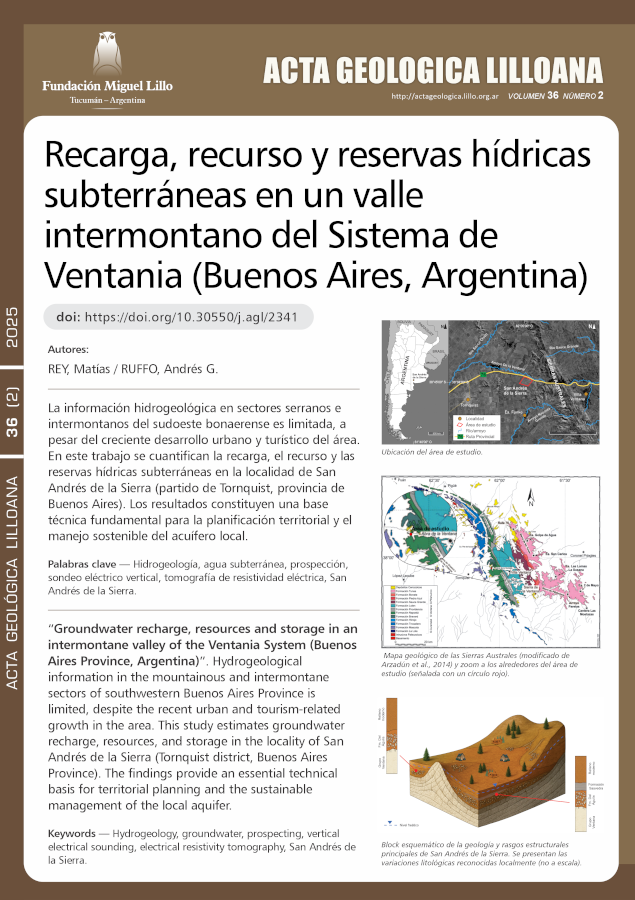
Hydrogeological information in the mountainous and intermontane sectors of southwestern Buenos Aires Province is limited, despite the recent urban and tourism-related growth in the area. This study estimates groundwater recharge, resources, and storage in the locality of San Andrés de la Sierra (Tornquist district, Buenos Aires Province) using an integrated approach that combines daily water-soil balance calculations to quantify recharge and groundwater resources, together with geoelectrical prospecting to determine saturated thicknesses and subsequently estimate groundwater reserves. Hydrogeological characteristics and aquifer thicknesses were defined through ten vertical electrical soundings and one electrical resistivity tomography, interpreted jointly with borehole cuttings and water-table measurements. Results indicate a mean annual recharge of 137,4 mm (15,2% of annual precipitation), representing a potential groundwater resource of 0,402 Hm³/year for the study area. The saturated thickness of the aquifer shows marked heterogeneity, with an average of 68 m and a maximum of 135 m, including an interdigitated clay layer acting as an aquitard. Spatial modelling of the hydrogeological basement and the water table allowed estimating available groundwater reserves at 28,03 Hm³. These findings provide an essential technical basis for territorial planning and the sustainable management of the local aquifer.
Downloads
References
Afridi, M.Z., Santha, N., Taweelarp, S., Ploymaklam, N., Khebchareon, M., Qamar, M.S. y Saenton, S. (2025). Groundwater Recharge Assessment and Recharge Zonation of the Intermontane Groundwater Basin, Chiang Mai, Thailand, Using a Groundwater Flow Model and Stable Isotopes. Sustainability, 17, 5560. https://doi.org/10.3390/su17125560 DOI: https://doi.org/10.3390/su17125560
Albouy, R. (1994). Hidrogeología de la cuenca superior del río Sauce Chico, Sierras Australes, Provincia de Buenos Aires. Tesis Doctoral (inédita). Universidad Nacional del Sur.
Arzadún, G., Tomezzoli, R.N., Cisternas, M.E., Cesaretti, N.N. y Fortunatti, N. (2014). Análisis diagenético y estructural en la Formación Tunas (Pozo PANG0001 – Pérmico de la Cuenca de Claromecó – Sierras Australes, Provincia de Buenos Aires, Argentina). En: 9° Congreso de Exploración y Desarrollo de Hidrocarburos, Actas, pp. 481–497. Mendoza.
Aureli, A., Ganoulis, J. y Margat, J. (2008). Groundwater resources in the Mediterranean region: importance, uses and sharing. Water Mediterr, 96-105.
Blarasin, M.T., Bécher Quinodóz, F.N., Adriana E.C., Matteoda, E.M., Alincastro, N. y Giuliano Albo, M.J. (2016). Weekly and Monthly Groundwater Recharge Estimation in A Rural Piedmont Environment using the Water Table Fluctuation Method. International Journal of Environmental & Agriculture Research (IJOEAR); 2; 5-2016; 104-113.
Campo de Ferreras, A., Capelli, A. y Diez, P. (2004). El clima del Sudoeste Bonaerense. Bahía Blanca: EdiUNS.
Carrica, J. (1993). Balshort: Un programa de balance hidrológico diario del suelo aplicado a la región sudoccidental pampeana. En: XII Congreso Geológico Argentino y II Congreso de Exploración de Hidrocarburos, Actas, Tomo VI, pp. 243–248.
Carrica, J. (1998). Hidrogeología de la cuenca del A° Napostá Grande, Provincia de Buenos Aires. Tesis Doctoral (inédita). Universidad Nacional del Sur.
De Francesco, F.O. (1992a). Estratigrafía del cenozoico en el flanco occidental de las Sierras de Curamalal, Sierras Australes Bonaerenses. En: III Jornadas Geológicas Bonaerenses, Actas, pp. 3–12. La Plata.
De Francesco, F.O. (1992b). Formación del Águila: depósitos pedemontanos en el sector occidental de Sierras Australes, Provincia de Buenos Aires. En: III Jornadas Geológicas Bonaerenses, Actas, pp. 13–17. La Plata.
FAO. (2008). FAO Water. Databases: Cropwat Decision Support System. Disponible en: http://www.fao.org/nr/water/infores_databases_cropwat.html (consultado el: 1 diciembre 2025).
Forte Lay, J.A. y Burgos, J.J. (1983). Verificación de los métodos de estimación de la variación de almacenaje en los suelos pampeanos. En: Taller argentino-estadounidense sobre sequías, Actas, pp. 162–180. Mar del Plata.
FUNS. (2017). Estudio hidrogeológico para abastecimiento de agua. Proyecto de urbanización: Jardines del Pillahuinco – barrio de montaña (Villa Arcadia, pdo. de Coronel Suárez). Informe inédito.
Hasan, M. y Shang, Y. (2022). Geophysical evaluation of geological model uncertainty for infrastructure design and groundwater assessments. Engineering Geology, 299, 106560. DOI: https://doi.org/10.1016/j.enggeo.2022.106560
González Uriarte, M. (2002). Geoambientes del Sudoeste Bonaerense. En: Vaquero, M. (comp.), Territorio, economía y medio ambiente en el Sudoeste Bonaerense. Bahía Blanca: EdiUNS.
Harrington, H.J. (1947). Explicación de las Hojas Geológicas 33m y 34m, Sierras de Curamalal y de la Ventana, Provincia de Buenos Aires. Boletín 61, S.I.C. 44, 42 p. Buenos Aires: Dirección de Minas y Geología.
Jasechko, S., Seybold, H., Perrone, D. Fan, Y., Shamsudduha, M., Taylor, R.G., Fallatah, O y Kirchner, J.W. (2024). Rapid groundwater decline and some cases of recovery in aquifers globally. Nature 625, 715–721. https://doi.org/10.1038/s41586-023-06879-8 DOI: https://doi.org/10.1038/s41586-023-06879-8
Ketchum, D., Talon Newton, B. y Phillips, F. (2016). High-resolution estimation of groundwater recharge for the Sandia/Manzano Mountains region (New Mexico). Reporte técnico NMWRRI. DOI: https://doi.org/10.56577/SM-2015.365
Kuang, X., Liu, J., Scanlon, B.R., Jiao, J.J., Jasechko, S., Lancia, M., Biskaborn, B.K., Wada, Y., Li, H., Zeng, Z., Guo, Z., Yao, Y., Gleeson, T., Nicot, J-P., Luo, X., Zou, Y. y Zheng, C. (2024). The changing nature of groundwater in the global water cycle. Science, 383(6686), eadf0630. DOI: https://doi.org/10.1126/science.adf0630
Kruse, E.E. (2015). Uso del agua subterránea y desarrollo sostenible. NÚCLEOS Revista Científica, pp. 30–37.
Lizzi, J.M, Garbulsky, M.F, Golluscio, R.A, y Deregibus, A.V. (2007). Mapeo indirecto de la vegetación de Sierra de la Ventana, provincia de Buenos Aires. Ecología austral, 17(2), 217-230.
Loke, M.H. (2004). Tutorial: 2D and 3D Electrical Imaging Surveys. Geotomo Software. Disponible en: http://www.geotomosoft.com/coursenote.zip (consultado el: 1 diciembre 2025). DOI: https://doi.org/10.1071/ASEG2004ab091
Min, L., Shen, Y. Pei, H. (2015). Estimating groundwater recharge using deep vadose zone data under typical irrigated cropland in the piedmont region of the North China Plain. Journal of Hydrology, 527, 305-315. DOI: https://doi.org/10.1016/j.jhydrol.2015.04.064
Mukherjee, A., Jha, M.K., Kim, K.W. y Pacheco, F. (2024). Groundwater resources: challenges and future opportunities. Sci Rep, 14, 28540. https://doi.org/10.1038/s41598-024-79936-5 DOI: https://doi.org/10.1038/s41598-024-79936-5
Nigro, J. y Perdomo, S. (2017). Desarrollo de software de inversión de datos 1D para sondeos eléctricos verticales Schlumberger. En: XXVIII Reunión Científica de la Asociación Argentina de Geofísicos y Geodestas (AAGG 2017) y Tercer Simposio IPSES, La Plata, Argentina.
Nouradine, H., Schamper, C., Valdes, D., Moussa, I., Ramel, D. y Plagnes, V. (2024). Integrating geological, hydrogeological and geophysical data to identify groundwater resources in granitic basement areas (Guéra Massif, Chad). Hydrogeol J 32, 759–784 (2024). https://doi.org/10.1007/s10040-024-02766-2 DOI: https://doi.org/10.1007/s10040-024-02766-2
Paoloni, J.D., Vázquez, R. y Fiorentino, E.C. (1988). La topografía y la variación de las precipitaciones y los escurrimientos en el sistema de Ventania. En: Segundas Jornadas Geológicas Bonaerenses, Actas, pp. 651–661. Bahía Blanca.
Patiño-Rojas S.M. y Jaramillo, M. (2022). Estimación espaciotemporal de la recarga potencial en un sistema pseudokárstico tropical. Rev. Acad. Colomb. Cienc. Ex. Fis. Nat. 46(178):261-278. https://doi.org/10.18257/raccefyn.1512 DOI: https://doi.org/10.18257/raccefyn.1512
Ponce, V.M. (2007). Rendimiento sostenible del agua subterránea. Disponible en: http://ponce.sdsu.edu/rendimiento.html (consultado el: 1 diciembre 2025).
Sala, J.M. (1975). Recursos hídricos de la provincia de Buenos Aires, especial mención de las aguas subterráneas. En: VI Congreso Geológico Argentino, Relatorio, pp. 169–193. Bahía Blanca.
Sasaki, Y. (1992). Resolution of resistivity tomography inferred from numerical simulation. Geophysical Prospecting, 40, 453–463. https://doi.org/10.1111/j.1365-2478.1992.tb00536.x DOI: https://doi.org/10.1111/j.1365-2478.1992.tb00536.x
Scanlon, B.R., Fakhreddine, S., Rateb, A., de Graaf, I., Famiglietti, J., Gleeson, T., Grafton, R.Q., Jobbagy, E., Kebede, S., Kolusu, S.R., Konikow, L.F., Long, D., Mekonnen, M., Müller Schmied, H., Mukherjee, A., MacDonald, A.,Reedy, R.C., Shamsudduha, M., Simmons, C.T., Sun, A. Taylor, R.G., Villholth, K.G., Vörösmarty, C.J. y Zheng, C. (2023). Global water resources and the role of groundwater in a resilient water future. Nature Reviews Earth & Environment, 4(2), 87-101. DOI: https://doi.org/10.1038/s43017-022-00378-6
Sendrós, A., Cabrera, M.D.C. y Casas-Ponsatí, A. (2025). Application of Geophysical Methods for Hydrogeology. Water, 17(1), 98. DOI: https://doi.org/10.3390/w17010098
Tapia-Villaseñor, E.M., Shamir, E., Cruz-Ayala, M.B. y Megdal, S.B. (2022). Assessing Groundwater Withdrawal Sustainability in the Mexican Portion of the Transboundary Santa Cruz River Aquifer. Water, 14(2), 233. https://doi.org/10.3390/w14020233 DOI: https://doi.org/10.3390/w14020233
UNESCO / WWAP. (2022). The United Nations World Water Development Report 2022: Groundwater – Making the Invisible Visible. United Nations World Water Assessment Programme (WWAP), UNESCO, Paris.
Uppasit, S. (2004). Groundwater Recharge Calculation of Chiang Mai Basin Using Water-Table Fluctuation Method. Tesis de Maestría. Universidad de Chiang Mai, Tailandia.
van der Gun, J. (2021). Groundwater resources sustainability. En: Global groundwater (pp. 331-345). Elsevier. DOI: https://doi.org/10.1016/B978-0-12-818172-0.00024-4
Wittenberg, H., Aksoy, H. y Miegel, K. (2019). Fast response of groundwater to heavy rainfall. Journal of Hydrology, 571: 837-842. https://doi.org/10.1016/j.jhydrol.2019.02.037 DOI: https://doi.org/10.1016/j.jhydrol.2019.02.037
Woessner, W.W. y Poeter, E.P. (2020). Hydrogeologic Properties of Earth Materials and Principles of Groundwater Flow. The Groundwater Project. https://doi.org/10.21083/978-1-7770541-2-0. DOI: https://doi.org/10.21083/978-1-7770541-2-0
Zohdy, A.R. (1989). A new method for automatic interpretation of Schlumberger and Wenner sounding curves. Geophysics, 42, 245–253. DOI: https://doi.org/10.1190/1.1442648
Downloads
Published
How to Cite
Issue
Section
License
Copyright (c) 2021 Acta Geológica Lilloana

This work is licensed under a Creative Commons Attribution-NonCommercial-NoDerivatives 4.0 International License.